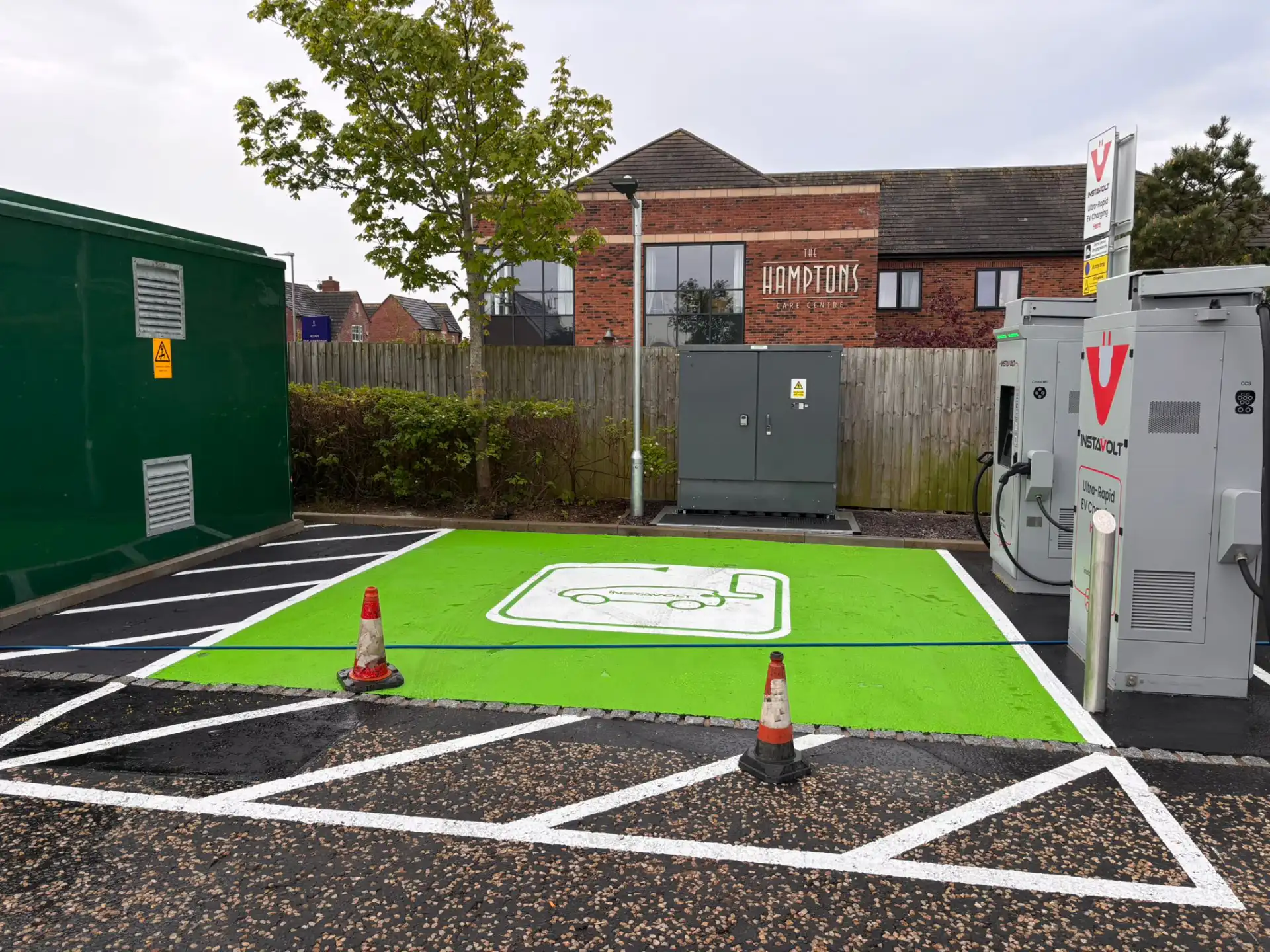
Most car park line removal is triggered by a layout change: more disabled bays, EV charging, a reworked one-way system, or a lease handback. The removal is often treated as a footnote to the new marking. It is the part that decides whether the new layout reads clearly, or leaves drivers following two sets of lines.
Why painting over old lines does not work
The quickest way to retire a bay line is to cover it with black paint. It looks right on the day. The problem is that the black paint sits on top of the old marking rather than replacing it, and it wears at a different rate from the tarmac around it. Within a season the old line comes back through as a pale shadow, and in low winter sun or on wet tarmac it can be easier to see than the new marking.
That matters beyond appearance. A car park with two overlapping layouts is a traffic management problem, and on a site with disabled or EV bays it can undermine the point of the change. If the old markings are being retired, they need to come off the surface, not be hidden by it.
How markings are actually removed
There is no single method, because the right one depends on what the marking is made from and what it is sitting on. The common approaches are worth knowing by name, so that a quote can be read properly.
Water-jetting at high or ultra-high pressure lifts paint and many thermoplastic markings without a mechanical cutting tool, and tends to suit larger areas of painted lines. Grinding removes the marking mechanically and is effective on thick thermoplastic, but it takes a thin layer of the surface with it. Shot blasting scours the surface with abrasive media and leaves a uniform texture. Heat is sometimes used to soften thermoplastic so that it can be lifted.
Why some ghosting is normal
Whatever the method, a removed line is rarely invisible. Tarmac is porous, and paint and thermoplastic leave a stain in the surface as well as a layer on top of it. On an older, weathered car park the surrounding surface has faded, so a freshly exposed strip can sit a different shade from its neighbours.
In practice this is usually acceptable, because it is covered by the new marking or is a faint trace rather than a defined line. It is still worth asking what a contractor expects to be left behind on your particular surface, and whether a follow-up treatment is likely, so that the result on the day is not a surprise.
What the surface can take
Removal is a trade-off between getting the marking off and keeping the surface intact. Aggressive grinding on a tired tarmac surface can pull out aggregate and open it up, which shortens its life and can leave a rougher strip than the one it replaced. Concrete and block paving behave differently again, and joints in block paving are easy to damage.
This is the reason a site assessment comes before a method. A contractor who quotes a fixed method without looking at the surface is guessing.
Questions worth asking before you book
Four questions separate a considered quote from a vague one. Which method will be used on this surface, and why? What is likely to remain once the markings are off? How will the debris and any wash water be dealt with, particularly where there are drains? And can the work be phased around trading so the whole car park is not out of use at once?
If the removal is part of a wider layout change, it also helps for the same contractor to be thinking about the new line marking at the same time, because the order of work and the finish of the removed lines both affect how the new layout looks.
Common Questions
Can you just paint over old car park lines?
You can, but the old marking usually shows through again as the paint wears, and it can be most visible on wet tarmac or in low sun. Where a layout is genuinely changing, removing the old lines is the more reliable route.
Will removing car park lines leave a mark?
Often a faint trace remains, particularly on older tarmac. How much depends on the marking material, the surface and the removal method. It is usually covered by the new layout or fades into the surface, and a contractor should be able to tell you what to expect on your site.
Which method is best for removing line markings?
There is no single best method. Water-jetting, grinding, shot blasting and heat are all used, and the right choice depends on the marking material, the surface type and its condition, and how much needs to come off.
Do car park lines need removing before new ones are painted?
Where the new layout differs from the old one, yes. Leaving old markings visible alongside new ones creates conflicting instructions for drivers, so the old lines should be removed rather than left in place.