
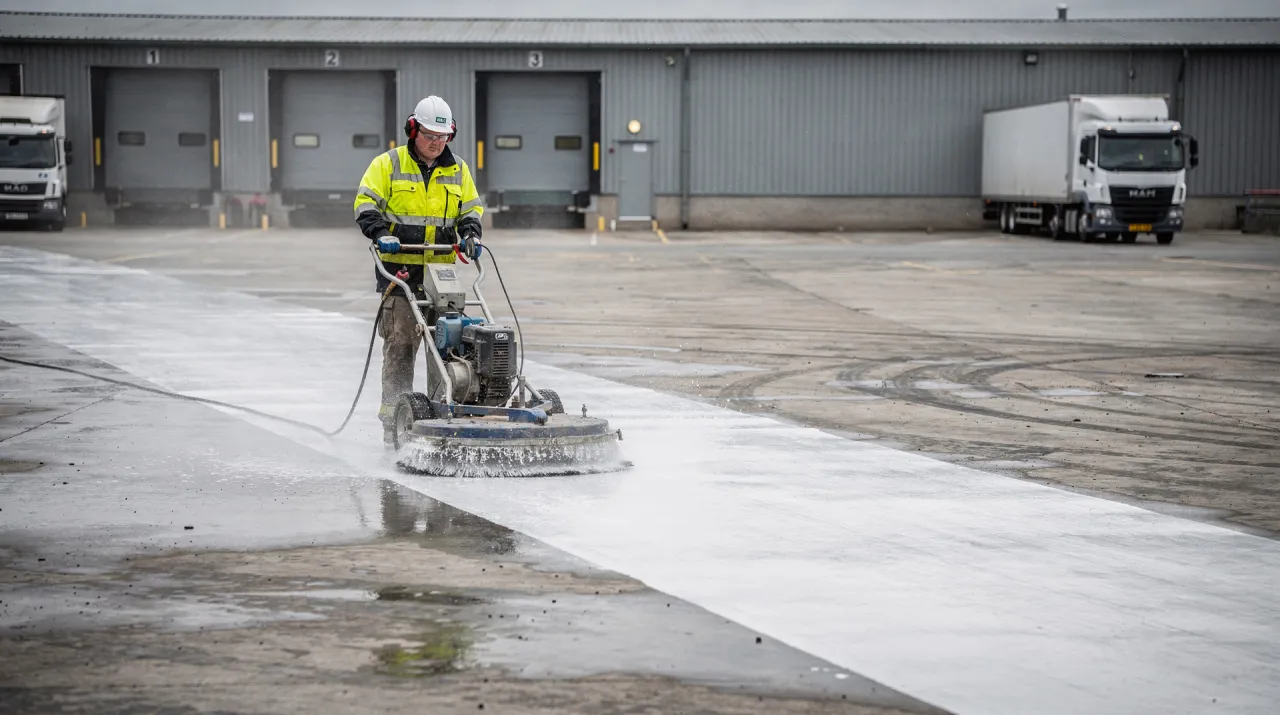
Most commercial pressure washing goes wrong in the same few places, and none of them are about how powerful the machine is. They are about where the water goes, when the work can happen, and whether the surface can take what is being pointed at it. If you are specifying this work for a site rather than a house, these are the questions worth asking before anyone quotes.
Where the water goes is a legal question, not a housekeeping one
This is the one that catches people out. Washing a commercial yard, car park or forecourt lifts hydrocarbons, silt, rubber and whatever else the site has deposited. That run-off has to go somewhere, and on most commercial sites the nearest gully is a surface water drain that discharges to a watercourse, not to foul sewer.
Allowing contaminated water into a surface water drain is a pollution offence, and the liability sits with the site as well as the contractor. It does not matter that the intent was to clean the place up.
A contractor who has done this work properly will raise containment before you do: bunding or mats over the gullies, a wet vacuum recovering the water, and either discharge to foul with the water company's agreement or removal by tanker. If nobody mentions the drains during the site visit, that tells you what you need to know.
Access decides the price more than area does
Two yards of identical size can be very different jobs. What moves the cost is whether the machinery can get to the surface, whether there is a water supply and power near enough to use, and how much of the area is obstructed by parked vehicles, stock or plant during working hours.
It is worth being honest at the quoting stage about what will actually be movable on the day. A car park quoted as empty and cleaned around forty parked cars is a different piece of work, and it will either cost more or come back looking patchy.
Out of hours is usually cheaper overall
It rarely feels that way, because the hourly rate is higher. But a yard cleaned in one uninterrupted overnight session is cleaned once. The same yard done in fragments around deliveries takes longer, needs repeated setting up and taking down, and leaves visible joins where sections were cleaned days apart.
For retail and distribution sites in particular, the disruption avoided is usually worth more than the premium paid.
The surface dictates the method
Pressure is not a single setting to be turned up until something works. Concrete hardstanding and block paving will take a rotary surface cleaner at working pressure. Cladding will not: profiled and composite panels need soft washing at low pressure with a chemical doing the work, because high pressure drives water behind the panel and past the seals.
Tarmac is somewhere between the two, and an aggressive lance will strip the bitumen binder and leave the surface open and grey. Anyone quoting the same method across every surface on a site has not looked at the site.
Check what the cleaning removes that you wanted to keep
Cleaning a car park to a good standard will lift faded line markings along with the grime, and a site that comes back clean but unmarked is not finished. If the bays, arrows, hatching or EV bays are worn, plan the reinstatement into the same visit rather than discovering the problem afterwards.
The same applies to anti-slip coatings on ramps and walkways. They wear, and a thorough clean will take the remainder of a coating that was already near the end of its life.
The paperwork is a proxy for competence
Ask for the risk assessment and method statement before the work, not after an incident. On a live commercial site it should name the containment method, the exclusion arrangements around the working area, and how pedestrians and vehicles are kept apart from it.
Working at height changes the picture again. Gutter and cladding work above ground level should specify how it is being reached and by whom, and high level clearing is generally safer and faster done from the ground with reach equipment than from a ladder.
Frequency beats intensity
The most expensive way to maintain a commercial surface is to leave it until it looks bad. Contamination that has been ground in over four years takes far more time, water and chemical to shift than the same site cleaned on a schedule, and the aggressive cleaning that heavy contamination requires is itself harder on the surface.
For most sites a planned annual or twice yearly clean costs less over five years than two emergency ones, and the surface lasts longer for it.
Common Questions
Can pressure washing run-off go into the nearest drain?
Not if it is a surface water drain, which most yard and car park gullies are. Water carrying hydrocarbons, silt or rubber has to be contained and either discharged to foul with the water company's agreement or tankered away. Getting it wrong is a pollution offence and the site carries liability alongside the contractor.
Does commercial work have to disrupt the site?
Rarely. Most commercial cleaning is done out of hours or in phased sections precisely so the site keeps operating. It usually works out cheaper than fragmenting the work around a live yard during the day.
Will cleaning damage cladding?
It will if it is pressure washed. Cladding needs soft washing at low pressure with the chemical doing the work. High pressure drives water past the panel seals and into the build-up, which is a far more expensive problem than the dirt was.
How often should a commercial yard be cleaned?
It depends on traffic and what is handled on site, but planned annual or twice yearly cleaning almost always costs less over time than leaving it until the contamination is ground in and the surface needs aggressive treatment.
Do line markings need redoing after cleaning?
Often, yes. A proper clean lifts worn markings along with the dirt. It is worth planning reinstatement into the same visit rather than finding out afterwards that the bays have gone.
