Every factory and warehouse has two cleaning regimes whether it plans for them or not. There is the floor-level clean that happens every shift, and there is everything above roughly head height, which nobody touches until there is a reason to. High-level cleaning is the second one, done on purpose instead of after an audit finding, a fire officer's comment or a complaint about something landing on a product.
What counts as high level
In practice it means any surface that settled dust can sit on and that the routine clean does not reach. In a typical industrial building that is a long list, and most of it is flat, horizontal and out of sight from the floor.
The top faces of steel beams and purlins hold the most, because they are wide, level and directly under the air currents that carry dust up from the floor. Racking tops come a close second in distribution buildings, where cardboard and pallet dust builds up on the highest beam level and on whatever is stored there for months at a time.
- Roof steelwork, purlins, beam tops and bracing
- Ducting, pipe runs and cable trays
- Light fittings, rooflight frames and high-level signage
- Top levels of racking and the stock stored on them
- Conveyor gantries, mezzanine edges and door heads
- Heaters, fans and the brackets that hold them
Why it is worth doing: fire, product and light
Fire is the reason that gets the job booked. A fine layer of dust spread across thousands of metres of steelwork is a large quantity of fuel stored where a fire would reach it first. Where a process produces combustible dust, from flour and sugar to wood, paper or some plastics, the Dangerous Substances and Explosive Atmospheres Regulations 2002 require the risk to be assessed and controlled, and settled dust at height is part of that risk. Even where the dust is not combustible in its own right, the building's fire risk assessment has to account for what is accumulating in it.
Product contamination is the reason that gets it booked again. Whatever is on a beam above an open line, a packing area or a goods-in bay will eventually come down, usually when a door is opened in a gale or a forklift mast clips a rack. Food, packaging and pharmaceutical sites see this in audits, and auditors are increasingly in the habit of looking up.
The third reason is the one people notice afterwards. Dust on light fittings and rooflights takes a surprising amount of light out of a building, and a high-level clean is often the first time in years that a warehouse floor gets the lux it was designed for.
Vacuumed, not blown down
The cheapest way to clean steelwork is a compressed air line, and it is the wrong way. Blowing dust off a beam does not remove it from the building. It lifts it into the air, which for a combustible dust is the most dangerous state it can be in, and then lets it settle again on machinery, stock and every lower surface in the bay. HSE guidance for dusty industries consistently tells employers not to clean with compressed air for exactly this reason.
Vacuuming takes the dust out of the building altogether. The vacuum unit matters as much as the method: industrial vacuums are classed L, M or H by the dust they are built to contain, and fine or hazardous dust needs a machine rated for it, otherwise the finest fraction simply passes through the filter and back into the room. That is a fair question to ask any contractor before they start.
Reaching it: from the floor, or from a lift
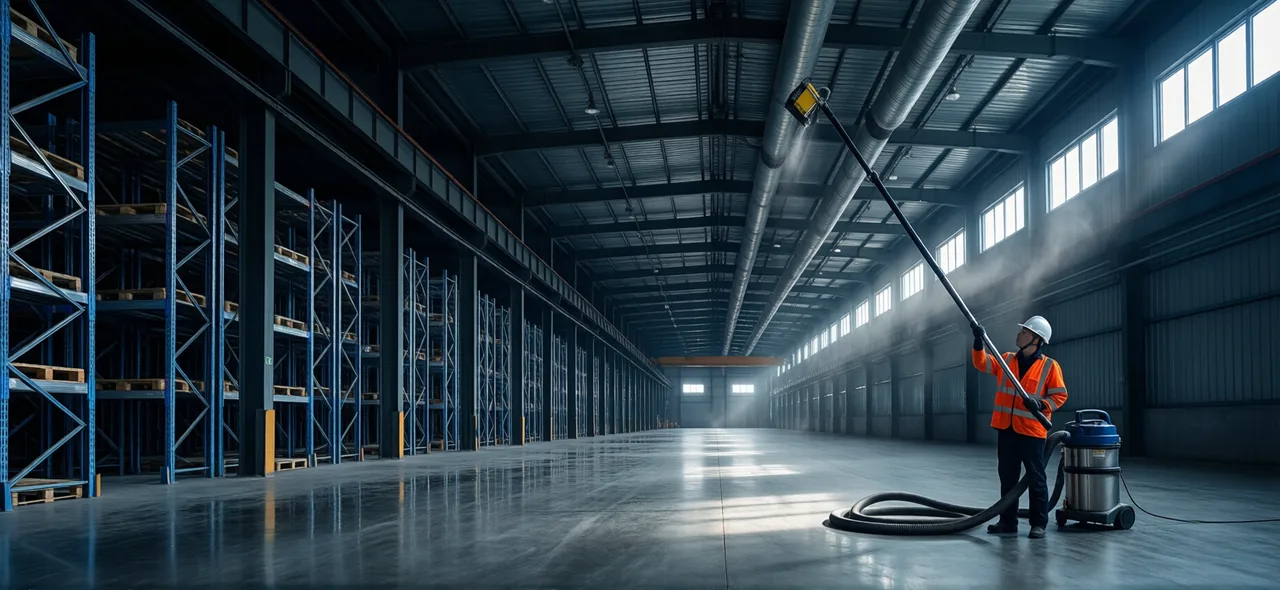
High-reach vacuum systems put the cleaning head on a long pole operated from floor level. That keeps the operative off the steelwork and out of a lift basket, and it means a racking aisle can be worked without bringing a machine into it. For a large share of a typical warehouse or factory roof, that is the quickest and least disruptive way in.
It is not the whole answer on every site. Very high roofs, areas boxed in by plant, and surfaces that need wiping as well as vacuuming may still need a powered access platform. A sensible survey decides which areas are poled and which need access equipment, rather than assuming a lift throughout and pricing the whole job around it.
Working in a building that does not stop
Most high-level cleaning is done in buildings that are still trading. The work is broken into zones so production or picking can carry on in the rest of the building, and anything sensitive beneath the zone being cleaned is covered, moved or timed so it is not there. Lines that cannot be protected are cleaned during shutdowns, at weekends or overnight.
This is where planning earns its keep. A method statement agreed in advance should say which zones are cleaned in which order, what is protected underneath, how the area is segregated from people and vehicles, and where the collected dust goes. If that is settled before the first shift, the cleaning itself is the easy part.
How often it needs doing
There is no correct interval that holds across buildings, and a single figure quoted without a survey is a guess. The rate dust builds up depends on what the process produces, how much air moves through the building, how often large doors are opened, and what sits underneath. A bakery or a joinery shop will load its steelwork far faster than a warehouse storing sealed goods.
The practical way to set it is to measure. A first full clean resets the building to zero. A walk round with a torch some months later shows how far it has come back, and on which surfaces, and the interval follows from that. Areas above open product or a dust-producing process will usually need cleaning more often than the rest of the roof, and there is no reason to clean the whole building at the frequency its worst bay needs.
- What the process produces, and whether that dust is combustible
- What sits underneath: open product, packed goods or empty floor
- Air movement, door openings and heating that carries dust upwards
- Any building work inside, which adds a layer all of its own
- What the fire risk assessment, insurer or auditor has asked for
What a quote should include
Two quotes for the same building can be far apart because they are not describing the same job. Before comparing prices, it is worth checking that each one states which surfaces are included, how each area will be reached, what class of vacuum will be used, what will be protected or moved beneath the work, when the work will happen, and how it will be shown to be done.
That last point is easy to overlook and hard to argue about later. Photographs of the steelwork before and after, zone by zone, are what a fire risk assessor, an insurer or a food safety auditor will want to see, and they are what makes the next interval a decision rather than a guess.
Common Questions
What is high-level cleaning?
Cleaning the surfaces in a building that the daily clean does not reach: roof steelwork, beam tops, ducting, pipework, light fittings and the top of racking. In factories and warehouses it is usually done with high-reach vacuum systems so the dust is taken out of the building rather than moved around it.
Is high-level cleaning a legal requirement?
No law sets an interval for it. But a building's fire risk assessment has to account for combustible material, including settled dust, and where a process produces combustible dust the DSEAR regulations require that risk to be assessed and controlled. High-level cleaning is how many sites meet those duties in practice.
Why not just blow the dust down with compressed air?
Because it does not remove the dust. It lifts it into the air, which is the most dangerous state for a combustible dust, and spreads it over machinery, stock and lower surfaces. HSE guidance for dusty industries advises against cleaning with compressed air. Vacuuming takes it away.
Does production have to stop?
Usually not across the whole building. The work is zoned so the rest of the site keeps running, with anything sensitive underneath covered or moved. Areas above lines that cannot be protected are done during shutdowns, at weekends or overnight.
Do you need a cherry picker or scissor lift?
Not for everything. High-reach vacuum poles work from floor level and cover a large share of most warehouse and factory roofs, including racking aisles. Very high or boxed-in areas may still need powered access, and the survey decides which is which.
High Reach Internal Vacuuming in Yorkshire
We are based in Wakefield and work across Yorkshire and nationwide. We assess access, surface condition and drainage before quoting.