
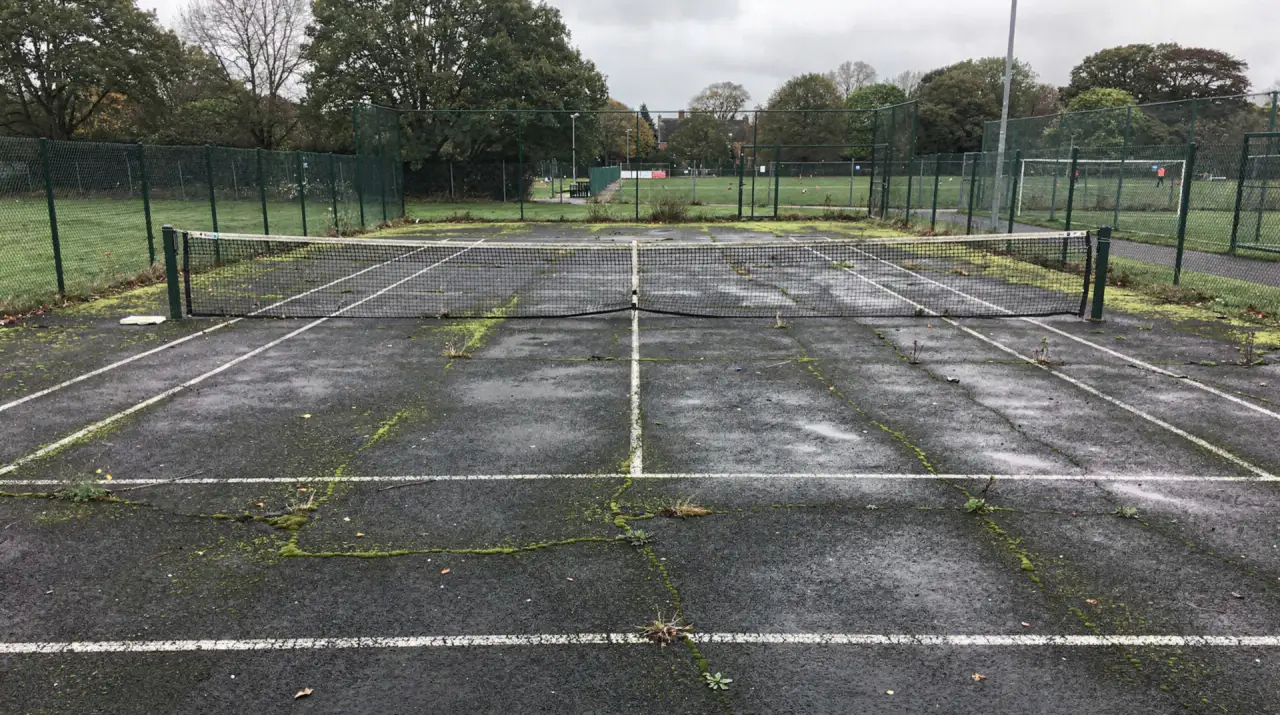
An outdoor court in this country does not wear out from play nearly as fast as it is overtaken by what grows on it. Moss along the fence line, a green film across the shaded end, weeds in the cracks and puddles that never seem to clear. Most of that is not a surfacing problem yet. It is a cleaning problem that has been left for a few seasons, and it is far cheaper to deal with at that stage than after it has become one.
What actually grows on a court
Three things do most of the damage. Algae forms a thin green or black film on any part of the surface that stays damp, and it is the one that makes a court slippery. Moss establishes along edges, in cracks and in any low spot where silt collects, and once it has a foothold it holds water and spreads. Lichen appears as pale crusty patches and bonds to the surface far more tightly than either.
The pattern is rarely even across a court. The end under trees, the strip beside a windbreak fence and any corner where leaves pile up in autumn will always be worse, because they are the parts that stay wet longest after rain and get the least sun. That matters when a clean is specified, because those areas need more treatment than the open middle of the court.
A slippery court is a safety problem first
Algae on a wet hard court can be as slippery as ice, and it is not always obvious until someone changes direction on it. Schools, councils, clubs and leisure operators owe a duty of care to the people using their facilities, and a visibly green court that someone has fallen on is a difficult thing to defend.
That is why the question is not only how the court looks. A court that has to be taped off after rain, or that coaches will not use for junior sessions, has already stopped doing its job, whatever the surface is like underneath.
Why porous courts stop draining
A large share of outdoor tennis, netball and multi-use courts are porous macadam. Rain is meant to soak straight through the surface into the base below, which is why a healthy porous court is playable soon after a shower. The pores that allow that are small, and they fill up. Silt, broken-down leaves, dust and organic growth gradually clog them, and when enough are blocked, water starts to sit on top.
Standing water then speeds up everything else. Algae grows faster on a surface that stays wet, moss gets a firmer hold, and in winter the water held in the top of the surface freezes and expands, which is how loose stones and crumbling patches begin. A clean that opens the pores again is as much about drainage as appearance, and it is the main reason cleaning extends the life of a porous court.
Non-porous courts, usually dense tarmac or concrete, shed water by falls rather than through the surface. They do not clog in the same way, but any low spot holds a puddle, and that puddle is where the algae starts.
How a court should be cleaned
The order of work matters more than the equipment. Loose debris and leaves come off first, particularly from fence lines and corners, so they are not simply washed into the surface. The court is then washed at a pressure set for its surface, working systematically so the whole area gets the same treatment rather than leaving stripes.
Pressure is where courts get damaged. Too much will loosen the aggregate on porous macadam, strip a painted or coated finish and lift line markings, and the court will look clean for a month and then start to fail. The aim is to remove what is in and on the surface, not the surface itself, so the setting is tested on a small area before the rest of the court is done.
Washing removes growth but leaves spores behind, so a biocide treatment follows to slow it coming back. Most biocides need a dry spell after application to work properly, so that part of the job is timed to a settled forecast rather than squeezed into a wet week. The water and debris from the wash should not be sent into surface water drains, which is worth checking before work starts.
- Leaves and loose debris cleared first, especially along the fences
- Pressure tested on a small area before the full court is washed
- An even, systematic wash rather than chasing the worst patches
- Biocide applied afterwards to slow regrowth, in dry weather
- Wash water and silt kept out of surface water drains
What cleaning will not fix
Cleaning reveals the surface as it really is, and occasionally that is not good news. Cracks, sunken areas, loose stone, a worn-through coating and faded lines will all still be there afterwards, and some will be easier to see. Those are jobs for a sports surfacing contractor, and a cleaning visit is a good moment to have them noted and photographed so that any repair can be planned rather than discovered.
Artificial grass pitches are a different job altogether. Sand-filled and rubber-crumb pitches need brushing, infill work and machinery that hard courts do not, so this guide is about hard courts only.
How often, and when
Many outdoor hard courts settle into a deep clean once a year, with shaded courts or those surrounded by trees needing attention more often. The useful measure is how quickly the growth returns after a proper clean and treatment: if the shaded end is green again within a few months, the interval is too long, or leaves are being left on the surface over winter.
Between deep cleans, the most valuable thing an operator can do is keep leaves and debris off the court through autumn. It costs almost nothing and removes the material that feeds the next season's moss.
Timing usually follows the users. School courts are best done in the holidays, club courts out of the main season, and public courts at quieter times of the week, with evening and weekend working where bookings make that necessary. On a sports ground with several courts, they can be cleaned one at a time so play carries on around the work.
Common Questions
How do you get moss and algae off a tennis court?
Clear the leaves and loose debris first, wash the court at a pressure set for its surface, then apply a biocide in dry weather to slow the growth returning. Scraping or very high pressure removes the moss but damages the surface along with it.
Will pressure washing damage a porous macadam court?
It can if the pressure is too high, because it loosens the aggregate and strips coatings and lines. Set correctly and tested on a small area first, washing opens up the clogged pores and helps the court drain again.
Why does water sit on our court after rain?
On a porous court it usually means silt and rotting leaves have filled the surface, so water can no longer soak through. On a non-porous court it points to a low spot or a blocked drainage channel. Cleaning fixes the first and shows up the second.
How often should an outdoor court be cleaned?
Many courts are deep cleaned once a year, with shaded courts or those under trees needing it more often. If growth is back within a few months of a clean and biocide treatment, the interval is too long.
Can the court be used straight after cleaning?
Once it is dry, in most cases. If a biocide has been applied, the product's own instructions set when the court can be used again, and that is agreed with the facility before the work is booked.
Sports Ground & Court Cleaning in Yorkshire
We are based in Wakefield and work across Yorkshire and nationwide. We assess access, surface condition and drainage before quoting.